

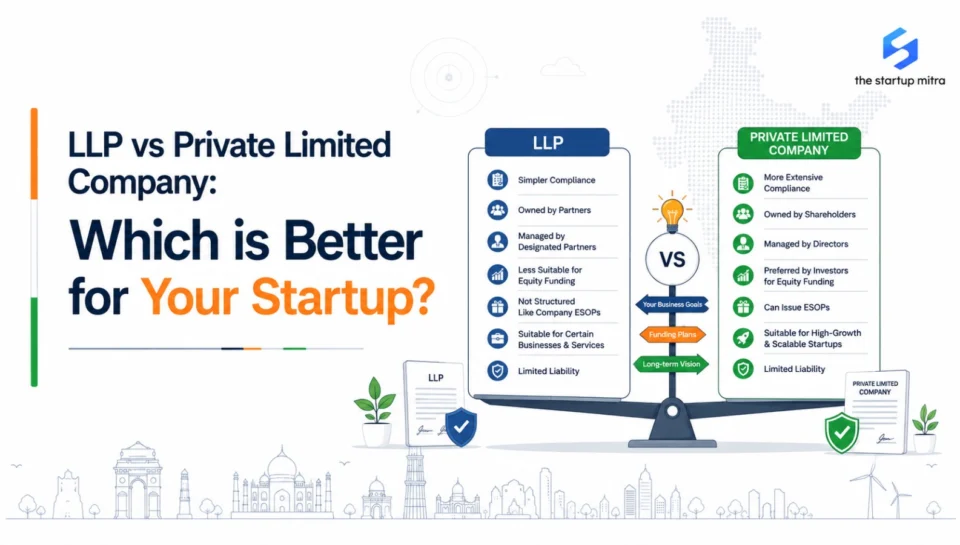
A Private Limited Company is generally better for startups planning to raise external funding, issue ESOPs, and scale rapidly. An LLP may be more suitable for founders who want operational flexibility, limited liability, and relatively simpler compliance requirements.
The right choice between an LLP and a Private Limited Company depends on the startup’s business model, funding plans, ownership structure, and long-term growth objectives.
What Is the Main Difference Between an LLP and a Private Limited Company?
An LLP, or Limited Liability Partnership, combines certain characteristics of a partnership with limited liability protection.
A Private Limited Company is a separate legal entity owned by shareholders and managed by directors.
Here is a simple comparison:
| Factor | LLP | Private Limited Company |
|---|---|---|
| Compliance | Relatively simpler | More extensive |
| Ownership | Partners | Shareholders |
| Management | Designated partners | Directors |
| External Investment | Less suitable for equity funding | Generally preferred by investors |
| ESOPs | Not structured like company ESOPs | Can issue ESOPs subject to applicable rules |
| Scalability | Suitable for certain businesses and professional services firms | Suitable for high-growth and scalable startups |
| Limited Liability | Yes | Yes |
When Is an LLP Better for a Startup?
An LLP may be suitable when the founders want to operate a professional services business, consulting company, agency, or closely held business.
An LLP can be considered when:
- The founders do not plan to raise venture capital
- The business has a small number of partners
- Operational flexibility is important
- The founders want relatively simpler corporate compliance
- Equity-based employee compensation is not a major requirement
For many service-based businesses, an LLP can provide a practical balance between operational flexibility and limited liability.
When Is a Private Limited Company Better?
A Private Limited Company is generally preferred by startups that want to build a scalable business and raise external capital.
It may be the better option when:
- The startup plans to approach angel investors
- Venture capital funding is part of the growth strategy
- The founders want to issue ESOPs
- The business may add multiple shareholders
- The founders are building a high-growth or technology startup
- A structured ownership model is required
Investors generally prefer company structures where ownership can be represented through shares and investment transactions can be structured accordingly.
Can Both LLPs and Private Limited Companies Get DPIIT Recognition?
Eligible Private Limited Companies and Limited Liability Partnerships can apply for recognition under the Startup India initiative, subject to applicable DPIIT eligibility requirements.
DPIIT recognition can provide eligible startups access to benefits related to tax exemptions, intellectual property support, easier compliance, and public procurement.
However, eligibility for individual benefits may vary depending on the legal structure and other applicable conditions.
Is It Easy to Convert an LLP Into a Private Limited Company?
Changing the business structure later can involve legal, tax, compliance, and administrative considerations.
Therefore, founders should consider their long-term plans before selecting an entity structure.
If external funding, ESOPs, or rapid expansion are likely to become important, starting with a Private Limited Company may reduce the need for restructuring later.
Final Answer
Choose an LLP if you are building a closely held business, professional services firm, or startup that does not plan to raise significant external investment.
Choose a Private Limited Company if you plan to raise funding, issue ESOPs, onboard investors, or build a rapidly scalable startup.
For most venture-backed and high-growth startups in India, a Private Limited Company is generally the more suitable structure.