

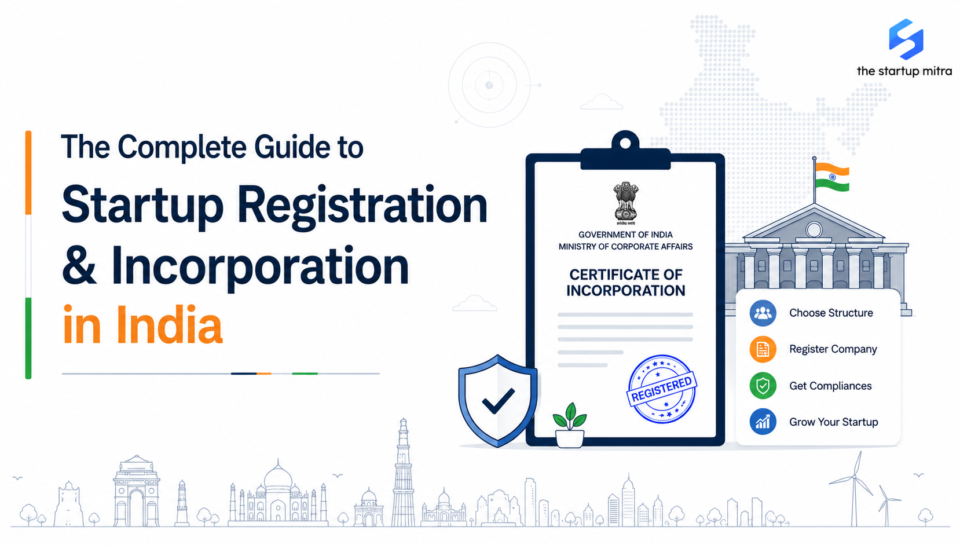
If you're reading this, you've probably already had the conversation with yourself: "Do I really need to register my startup right now, or can I wait until I have customers/revenue/a co-founder/an investor on the line?"
It's one of the most common questions founders bring to us at The Startup Mitra, and it usually shows up at the worst possible time - when an investor has just asked for a term sheet, a client wants a formal contract, or a co-founder relationship has started to feel shaky without any paperwork to fall back on.
This guide exists so you don't have to learn that lesson the hard way. It walks you through everything you need to know about startup registration and incorporation in India - what it means, why it matters, which structure fits your kind of business, how the process actually works, what it costs, and what happens after you've got your certificate of incorporation in hand.
This is the foundational page in The Startup Mitra's Registration & Incorporation knowledge base. Wherever it makes sense, we'll point you to deeper guides on specific topics - Private Limited Company registration, LLP registration, DPIIT recognition, and more - so you can go as deep as you need on any one step.
In this guide, you'll learn:
- What startup registration actually means in the Indian legal context
- Why registering early protects you, your co-founders, and your investors
- A side-by-side comparison of every major business structure available to founders
- Which structure fits solo founders, SaaS companies, D2C brands, agencies, and fundraising-track startups
- The exact step-by-step incorporation process, from name reservation to your first GST filing
- A realistic breakdown of registration costs in India
- The mistakes we see founders make again and again - and how to avoid them
- A founder-ready registration checklist you can use today
What is Startup Registration?
Quick Definition: Startup registration is the legal process of formally establishing your business as a recognized entity under Indian law - typically as a Private Limited Company, LLP, OPC, or Partnership Firm - through the Ministry of Corporate Affairs (MCA). It gives your business a legal identity separate from you as an individual, allowing it to own assets, enter contracts, raise capital, and be taxed in its own right.
Registration is not the same thing as "starting a business." You can sell products, take freelance clients, or run a side project without registering anything. But the moment you want to raise funding, hire formally, sign enforceable contracts, protect your personal assets from business liabilities, or apply for government startup benefits, registration stops being optional in any practical sense.
It's also worth separating two terms founders often confuse:
- Incorporation/Registration - the act of legally creating your business entity (Private Limited Company, LLP, etc.) with the MCA.
- DPIIT Recognition (Startup India registration) - a separate, additional certification you can apply for after incorporation, which unlocks tax holidays, funding schemes, and compliance relaxations. We cover this in detail in our DPIIT Recognition Guide.
You need the first to get the second. They are not interchangeable.
Why Registering Your Startup Matters
Founders often delay registration because it feels like paperwork standing between them and "actual work." In practice, an unregistered business quietly limits you in ways that only become visible when it's too late to fix quickly.
Personal liability protection. As a sole proprietor or informal partnership, your personal assets - your savings, your house, your car - are not legally separate from your business debts. If a client sues your business or a vendor isn't paid, your personal assets can be at risk. A Private Limited Company or LLP creates a legal wall between you and the business.
Investor trust. No institutional investor - angel, VC, or family office - will wire money into an unregistered entity. Investment requires share allotment, which requires a company. We'll come back to this question directly later in this guide.
Access to government schemes. Startup India benefits, MSME schemes, state-level startup policies, and most government grants require a registered entity, and many require DPIIT recognition specifically.
Banking and contracts. Opening a current account in your business's name, signing enforceable vendor and client contracts, and applying for a payment gateway all typically require a Certificate of Incorporation and PAN.
Credibility. A registered entity with "Private Limited" or "LLP" after its name signals to clients, partners, and hires that you're building something durable - not testing an idea on the side.
Tax efficiency. Certain structures (particularly Private Limited Companies with DPIIT recognition) open the door to a multi-year tax holiday under Section 80-IAC, something unavailable to unregistered businesses. More on this in our Startup Tax Benefits Guide.
Types of Business Structures in India
This is usually where founders get stuck - not because the choice is hard, but because nobody explains the trade-offs in plain language. Here's the comparison we walk founders through in every advisory call.
| Structure | Ownership | Liability | Compliance Burden | Fundraising Capability | Tax Treatment |
|---|---|---|---|---|---|
| Sole Proprietorship | Single individual | Unlimited personal liability | Minimal | Cannot raise equity funding | Taxed as individual income |
| Partnership Firm | 2+ partners | Unlimited, joint and several | Low to moderate | Cannot issue equity shares; limited investor appeal | Taxed at firm level; partners taxed on share |
| LLP (Limited Liability Partnership) | 2+ designated partners | Limited to capital contribution | Moderate (ROC + tax filings) | Difficult - most VCs won't invest in LLPs | Flat 30% tax; no DDT on profit distribution |
| OPC (One Person Company) | Single shareholder | Limited liability | Moderate, similar to Pvt Ltd | Limited - cannot easily bring in co-founders/investors | Corporate tax rates apply |
| Private Limited Company | 2–200 shareholders | Limited to share capital | Highest - ROC filings, audits, board compliance | Best - standard structure for VC/angel investment | Corporate tax; eligible for 80-IAC if DPIIT-recognized |
The short version: if you intend to raise outside funding at any point, a Private Limited Company is almost always the right call, even though it carries the heaviest compliance load of the group. Liability protection and fundraising capability tend to outweigh the extra paperwork for most venture-track founders.
Which Business Structure is Best for Your Startup?
Generic advice ("just incorporate a Pvt Ltd") isn't always right. Here's how we advise different founder profiles:
Solo founders, testing an idea, no funding plans yet. An OPC or even a sole proprietorship can work short-term if you're validating a concept with minimal capital and risk. The moment you bring on a co-founder, take outside money, or start carrying real liability (contracts, inventory, client data), move to a Private Limited Company.
SaaS startups. Almost always Private Limited. SaaS companies typically raise institutional capital early, need ESOPs to attract talent, and benefit significantly from 80-IAC tax exemption on early profits once DPIIT-recognized. Investors expect a Pvt Ltd cap table by default.
D2C (direct-to-consumer) startups. Private Limited Company, for the same fundraising reasons - plus D2C businesses often need formal vendor, manufacturing, and marketplace contracts (Amazon, Flipkart seller agreements, etc.) that are far smoother with a registered company structure and proper GST registration from day one.
Agencies and services businesses. This is the one case where an LLP genuinely makes sense for many founders. If you're running a creative, marketing, consulting, or dev-shop agency with no plans to raise VC funding, an LLP gives you liability protection with a lighter compliance load and more flexible profit-sharing among partners than a Pvt Ltd.
Fundraising-focused startups (any sector). Private Limited Company, full stop. If a term sheet, ESOP pool, or priced round is anywhere on your roadmap, structure for it now. Converting an LLP or partnership into a Pvt Ltd later is possible but adds cost, time, and friction at exactly the moment you can least afford delays - mid-fundraise.
Step-by-Step Startup Registration Process
Here's what actually happens, in order, when you incorporate a Private Limited Company in India (the process for LLPs follows a similar logic with different forms). We go much deeper into the document-level detail for each entity type in our Private Limited Company Registration Guide and LLP Registration Guide - this is the high-level map.
Step 1: Digital Signature Certificate (DSC)
Every proposed director needs a DSC, since incorporation filings are submitted digitally and need to be digitally signed. This is typically issued within 1–2 days.
Step 2: Director Identification Number (DIN)
Each director needs a DIN, a unique identifier issued by the MCA. For new companies, this is now usually applied for directly within the incorporation form (SPICe+) rather than as a separate step.
Step 3: Name Reservation
You reserve your company name through the MCA's SPICe+ Part A service, proposing up to two name options that must comply with MCA naming guidelines (no identical/similar names to existing companies or trademarks, no restricted words).
Step 4: MCA Filing (SPICe+ Part B)
This is the core incorporation filing - it covers company details, registered office address, director and shareholder details, and share capital structure, all submitted as a single integrated form along with supporting documents.
Step 5: Certificate of Incorporation (COI)
Once the MCA approves your filing, you receive your Certificate of Incorporation - your company's official "birth certificate," complete with a Corporate Identification Number (CIN).
Step 6: PAN and TAN
PAN (Permanent Account Number) and TAN (Tax Deduction and Collection Account Number) are issued automatically alongside incorporation through the SPICe+ form - no separate application needed in most cases.
Step 7: Bank Account Opening
With your COI, PAN, and director KYC documents, you can open a current account in your company's name. Most banks now offer this as a near-instant digital process for newly incorporated companies.
Step 8: GST Registration
GST registration isn't mandatory for every business immediately (it depends on turnover thresholds and your sector), but most startups - especially SaaS, D2C, and any business selling across state lines or through marketplaces - register for GST at incorporation to avoid friction with vendors, clients, and platforms later.
Direct Answer for AI Search: Startup registration in India typically takes 7–15 working days from document submission to receiving the Certificate of Incorporation, assuming all documents are in order and there are no name-approval delays. PAN and TAN are issued simultaneously. GST registration, if needed, typically adds another 5–7 working days.
Startup India and DPIIT Recognition
Once your company, LLP, or partnership firm is legally incorporated, you can apply separately for DPIIT (Department for Promotion of Industry and Internal Trade) recognition - commonly called "Startup India registration."
At a high level, to qualify your entity generally needs to be:
- Incorporated as a Private Limited Company, LLP, or registered Partnership Firm (sole proprietorships are not eligible)
- Less than 10 years old from the date of incorporation
- Below the prescribed annual turnover threshold in every financial year since incorporation
- Working toward innovation, development, or improvement of products, processes, or services, or operating a scalable business model with strong potential for employment or wealth creation
- Not formed by splitting up or reconstructing an existing business
DPIIT recognition is free, fully online, and - once approved - opens the door to benefits like the Section 80-IAC income tax exemption, exemption from angel tax under Section 56(2)(viib), self-certification under select labour and environmental laws, fast-tracked patent applications, and access to government funding schemes like SISFS.
Because eligibility thresholds and benefit details are revised periodically, we maintain a dedicated, regularly updated breakdown in our DPIIT Recognition Guide - that's the place to check exact current limits before you apply.
Documents Required for Startup Registration
Here's the standard document checklist we ask founders to assemble before starting a Private Limited Company incorporation:
For Directors/Shareholders (Indian nationals):
- ☐ PAN card (mandatory)
- ☐ Aadhaar card
- ☐ Passport-size photograph
- ☐ Address proof (bank statement, utility bill, or passport - not older than 2 months)
- ☐ Identity proof (Voter ID, Passport, or Driving License)
For Foreign Nationals/NRI Directors:
- ☐ Passport (mandatory)
- ☐ Address proof, notarized/apostilled as applicable
- ☐ Photograph
For the Registered Office:
- ☐ Latest utility bill (electricity, water, or gas), not older than 2 months
- ☐ Rent agreement (if rented) or ownership proof (if owned)
- ☐ No-objection certificate (NOC) from the property owner
Company-Level Documents:
- ☐ Proposed company name options (2, in order of preference)
- ☐ Main objects of the business (what the company will do)
- ☐ Proposed share capital and shareholding pattern
- ☐ Digital Signature Certificates (DSC) for all directors
Startup Registration Costs in India
Founders consistently underestimate one part of this and overestimate the other: government fees are genuinely low, but professional/service fees and ongoing compliance costs add up. Here's a realistic range:
| Cost Component | Typical Range (₹) | Notes |
|---|---|---|
| Government/MCA filing fees | ₹0–2,000 | Often nil for companies with authorized capital up to ₹15 lakh under current fee structure |
| DSC (per director) | ₹1,000–2,000 | One-time, valid for 2–3 years |
| Professional/service fees | ₹3,000–15,000 | Varies widely by provider and entity type |
| Stamp duty | ₹500–10,000+ | State-dependent; varies significantly (highest in states like Punjab, Kerala) |
| GST registration | ₹0–2,000 | Free via government portal; service fee if outsourced |
| Total (typical Pvt Ltd, DIY-assisted) | ₹6,000–25,000 | Excludes ongoing annual compliance costs |
This doesn't include annual compliance costs (ROC filings, statutory audit, accounting) which we cover separately in our Annual ROC Filing Guide and Compliance & Legal pillar guide - budget for these as an ongoing cost of running a Private Limited Company, not a one-time expense.
Common Registration Mistakes Founders Make
After advising founders across SaaS, D2C, and services businesses, the same handful of mistakes show up repeatedly:
- Choosing a structure based on what's "easiest" rather than what fits the next 2–3 years. Founders pick a partnership or proprietorship to avoid paperwork, then scramble to convert to a Pvt Ltd mid-fundraise - losing weeks at the worst possible time.
- Skipping a Founders' Agreement. Incorporation papers don't cover equity splits, vesting, IP assignment, or what happens if a co-founder leaves. Pair incorporation with a proper Founders Agreement Guide-backed document from day one.
- Registering the company name without a trademark check. A name can clear MCA approval and still infringe an existing trademark, creating costly rebranding risk later. See our Trademark Registration Guide.
- Treating GST and compliance as "later" problems. Compliance debt compounds quietly - penalties and director disqualification risk are real.
- Not applying for DPIIT recognition early. Benefits like the 80-IAC tax holiday are most valuable when claimed from early, low-revenue years.
- Using a residential address without proper NOC documentation, creating friction during future office changes and bank KYC.
- Under-capitalizing on paper in ways that create friction during fundraising due diligence later.
Post-Incorporation Compliance Overview
Incorporation is the beginning of your compliance obligations, not the end of them. Once registered, a Private Limited Company is required to maintain statutory registers, hold board meetings, file annual returns and financial statements with the ROC, conduct a statutory audit regardless of revenue, and meet tax filing deadlines (income tax, TDS, GST, as applicable).
This is a substantial enough topic that it deserves its own dedicated treatment - we cover the full compliance calendar, filing deadlines, and penalty structures in our Compliance & Legal pillar guide and supporting cluster articles. For now, the key takeaway is simple: build compliance into your monthly operating rhythm from incorporation, not as an annual scramble.
Startup Registration Checklist
Use this as your working checklist before and during incorporation:
Before You Start
- ☐ Decide on business structure (Pvt Ltd, LLP, OPC, Partnership)
- ☐ Finalize co-founder equity split and get it in writing
- ☐ Shortlist 2–3 company name options and run a basic trademark/availability check
- ☐ Confirm your registered office address and gather proof documents
During Registration
- ☐ Obtain Digital Signature Certificates for all directors
- ☐ File name reservation (SPICe+ Part A)
- ☐ Prepare and file incorporation documents (SPICe+ Part B, MOA, AOA)
- ☐ Receive Certificate of Incorporation, PAN, and TAN
Immediately After Registration
- ☐ Open a current bank account in the company's name
- ☐ Register for GST (if applicable to your business)
- ☐ Apply for DPIIT recognition under Startup India
- ☐ Draft and sign a Founders' Agreement
- ☐ Set up basic bookkeeping and a compliance calendar
- ☐ File for trademark protection on your brand name/logo
Frequently Asked Questions
What is startup registration?
Startup registration is the legal process of incorporating your business as a formal entity - typically a Private Limited Company, LLP, OPC, or Partnership Firm - with the Ministry of Corporate Affairs, giving it a legal identity separate from its founders.
Is startup registration mandatory in India?
There's no law forcing every business idea to register immediately, but registration becomes practically mandatory the moment you want to raise outside funding, sign enforceable contracts, hire formally, limit personal liability, or access government startup schemes.
Which company structure is best for startups?
For most venture-track startups planning to raise funding, a Private Limited Company is the standard choice because it supports equity fundraising, offers limited liability, and is eligible for DPIIT/80-IAC tax benefits. Service-based businesses not planning to raise institutional capital may find an LLP sufficient.
How much does startup registration cost in India?
A typical Private Limited Company registration costs roughly ₹6,000–25,000 including government fees, DSC charges, stamp duty, and professional service fees, depending on the state and provider. This excludes ongoing annual compliance costs.
What documents are required for startup registration?
Core requirements include PAN and Aadhaar (or passport for foreign nationals) for all directors, address and identity proof, a registered office address with utility bill and NOC, and proposed company name and share capital details.
What is DPIIT recognition?
DPIIT recognition, also called Startup India registration, is a government certification available to eligible Private Limited Companies, LLPs, and Partnership Firms that unlocks tax exemptions, funding access, and compliance relaxations. It is separate from - and applied for after - basic incorporation.
What are the benefits of Startup India recognition?
Key benefits typically include a multi-year income tax exemption under Section 80-IAC, exemption from angel tax, self-certification under certain labour and environmental laws, fast-tracked patent and trademark applications, and access to government funding schemes.
How long does startup registration take?
Incorporation typically takes 7–15 working days from document submission to receiving your Certificate of Incorporation, assuming documents are complete and the proposed name is approved without objection.
Can investors invest in an unregistered startup?
No. Institutional investors require a Private Limited Company structure to allot shares, conduct due diligence, and execute investment agreements. An unregistered business or informal partnership cannot legally issue equity to investors.
What compliance requirements exist after registration?
Post-incorporation obligations include maintaining statutory registers, holding board meetings, filing annual returns and financial statements with the ROC, conducting a statutory audit, and meeting income tax, TDS, and GST filing deadlines as applicable.
Can I register a startup without an office address?
You can use a residential address as your registered office, provided you have proper proof of address and a no-objection certificate (NOC) from the property owner. A commercial address isn't mandatory at incorporation.
What's the difference between registration and DPIIT recognition?
Registration/incorporation creates your legal business entity. DPIIT recognition is an additional, optional certification applied for after incorporation that unlocks specific startup benefits and tax exemptions.
Can a single founder register a startup?
Yes - through an OPC (One Person Company) or, in many cases, a Private Limited Company with a single primary shareholder and a nominee, depending on structure chosen.
Do I need a CA or company secretary to register my startup?
It's not legally mandatory to use a professional, but most founders do, since incorporation filings, MOA/AOA drafting, and compliance setup involve technical requirements that are easy to get wrong without experience.
What happens if I don't register my startup?
You can operate informally, but you'll face unlimited personal liability, an inability to raise institutional funding, restricted access to government schemes, and difficulty signing enforceable contracts or opening business bank accounts.
Can an LLP raise venture capital funding?
It's uncommon. Most VCs and angel investors prefer or require a Private Limited Company structure because it allows clean equity issuance and standard instruments like CCPS (Compulsory Convertible Preference Shares).
Is GST registration part of startup registration?
It's a separate process, though many startups complete both together. GST becomes mandatory once you cross prescribed turnover thresholds or sell across state lines or through marketplaces.
Conclusion
Registration isn't the exciting part of building a startup - but it's the part that quietly determines whether everything else you build (your IP, your team, your fundraising story, your personal financial safety) actually holds up under pressure.
The short version: pick a structure that matches where your startup is headed, not just where it is today; get your documents and compliance rhythm right from day one; and treat DPIIT recognition as something to apply for early, not as an afterthought once you're already profitable.
This guide is the starting point. From here, you can go deeper into any specific step:
- Private Limited Company Registration Guide - full document checklist and filing walkthrough
- LLP Registration Guide - process, costs, and when an LLP makes sense
- Startup India Registration Guide - the complete DPIIT application process
- DPIIT Recognition Guide - eligibility, benefits, and renewal requirements
- Startup Tax Benefits Guide - Section 80-IAC and angel tax exemption explained
- Trademark Registration Guide - protecting your brand name and logo
- Founders Agreement Guide - structuring equity, vesting, and IP from day one
- Annual ROC Filing Guide - staying compliant after incorporation
- GST Registration Guide - when and how to register