
Quick Answer:
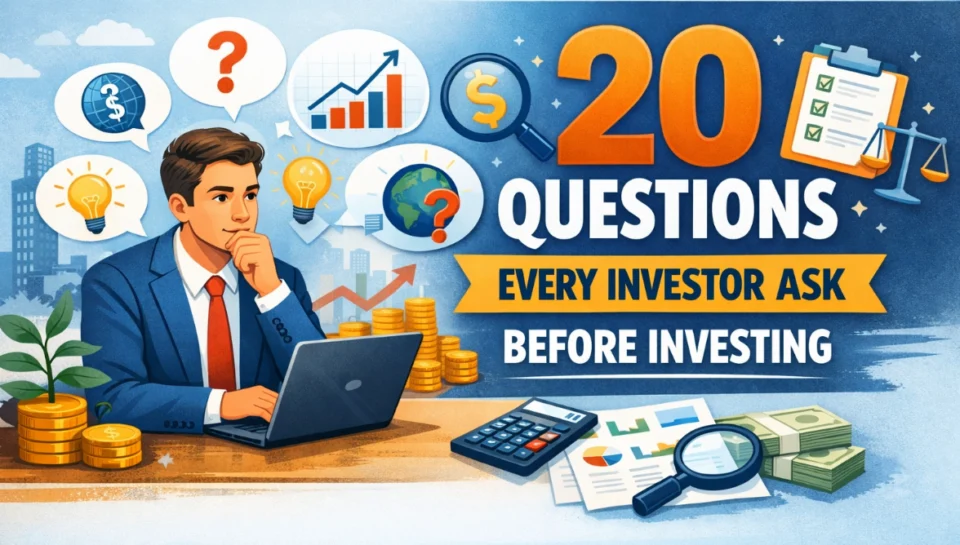
Before writing a check, every investor runs through the same mental checklist — Team, Market, Traction, Business Model, and Moat. This blog breaks down the 20 most common questions investors ask early-stage founders, what they're really evaluating, and exactly how you should answer them.
You've spent six months building. You finally land a meeting with an investor. The conversation starts well — they seem interested, they're leaning in, they're asking questions.
And then it hits you: you're not sure if your answers are landing.
This is where most early-stage fundraising falls apart. Not because the idea is bad. Not because the traction isn't there. But because founders walk into investor meetings without understanding what the questions are really asking.
Investors don't just want information. They're running a risk assessment in real time. Every question is a signal — and every answer either builds or erodes their confidence in you.
Why These Questions Matter at the Early Stage
At the early stage, investors have almost nothing concrete to evaluate. There's no decade of financial history, no massive customer base, no proven exit track record. So what do they do? They evaluate risk.
Every question an investor asks is designed to answer one of two things:
- How big could this get? (upside potential)
- What could go wrong? (downside risk)
The mistake most founders make is treating investor meetings like a product demo. But investors aren't buying a product. They're buying into a story about the future, told by someone they believe can execute it.
The 5 Buckets Behind Every Investor Question
Every investor question maps back to one of five core areas. Understand these buckets, and you'll understand the intent behind any question they throw at you.

Team
Can these people actually build this?

Market
Is the opportunity large enough?

Traction
Has anyone validated this beyond a deck?

Business Model
How does this actually make money?

Moat
Why can't someone copy this in 6 months?
Every one of the 20 questions below maps back to one of these five buckets.
20 Questions Investors Will Ask Before Funding Your Startup
Team Questions (Q1–Q4)
Investors bet on people before they bet on ideas.
"Tell me about your background — why are you the right person to build this?"
🔍 WHAT INVESTORS ARE REALLY EVALUATING
Founder-market fit. They want to know if you have the domain expertise, lived experience, or unfair advantage that makes you the right person for this specific problem.
💡 HOW TO ANSWER IT
Don't recite your resume. Connect your experience directly to the problem. If you spent five years in the industry you're disrupting, say so. If you lived the pain point yourself, lead with that. The best answers show why you and why now — not just who you are.
"How did you and your co-founder meet? How do you divide responsibilities?"
🔍 WHAT INVESTORS ARE REALLY EVALUATING
Team cohesion and complementary skill sets. A founding team that met last month over LinkedIn raises different flags than one that has worked together for years.
💡 HOW TO ANSWER IT
Be specific about your shared history and honest about how you split work. Investors want to see clear ownership — not two generalists who both 'do everything.'
"What happens to the company if you leave?"
🔍 WHAT INVESTORS ARE REALLY EVALUATING
Key-person risk. This is a hard question designed to see if the business is founder-dependent or if there's a team and structure that could survive a setback.
💡 HOW TO ANSWER IT
Don't get defensive. Acknowledge the risk honestly, then explain what you've done to build a team, document systems, and reduce dependency. If the company would collapse without you, that's something to work on before your next meeting.
"Have you had a major disagreement as co-founders — how did you handle it?"
🔍 WHAT INVESTORS ARE REALLY EVALUATING
Conflict resilience. Startups are stressful. Investors need to know your founding team can disagree and still move forward.
💡 HOW TO ANSWER IT
If you have a real story of a disagreement and resolution, share it — it shows maturity. Saying "we've never disagreed" is a red flag. It usually means someone isn't being heard.
📊 Market Questions (Q5–Q8)
A great team solving a small problem is still a small outcome.
"How big is the market? How did you arrive at that number?"
🔍 WHAT INVESTORS ARE REALLY EVALUATING
Market sizing discipline. Top-down numbers like "it's a $50 billion market" mean almost nothing. Investors want to see bottom-up thinking that shows you understand your actual addressable opportunity.
💡 HOW TO ANSWER IT
Work from the ground up. How many potential customers exist? What would each pay annually? Build the math from real data points, not industry reports. Show TAM, SAM, and SOM — and explain the difference between them.
"Who is your target customer, and what does their day look like before and after your product?"
🔍 WHAT INVESTORS ARE REALLY EVALUATING
Customer empathy and clarity. Vague answers like "SMBs" or "millennials" signal that you haven't done real customer discovery.
💡 HOW TO ANSWER IT
Name a specific customer archetype. Describe their problem in precise terms. Explain how your product changes their workflow, saves them money, or removes a frustration. The more specific, the better.
"What trends are driving this market right now?"
🔍 WHAT INVESTORS ARE REALLY EVALUATING
Market timing. The best businesses ride tailwinds — regulatory shifts, behavioral changes, new technology unlocks. Investors want to know if now is the right moment for this idea to exist.
💡 HOW TO ANSWER IT
Identify two or three concrete macro trends that make this the right moment. Explain why this problem couldn't have been solved — or solved as well — three years ago, and what's changed.
"Who else is working on this problem?"
🔍 WHAT INVESTORS ARE REALLY EVALUATING
Market timing. The best businesses ride tailwinds — regulatory shifts, behavioral changes, new technology unlocks. Investors want to know if now is the right moment for this idea to exist.
💡 HOW TO ANSWER IT
Identify two or three concrete macro trends that make this the right moment. Explain why this problem couldn't have been solved — or solved as well — three years ago, and what's changed.
"Who else is working on this problem?"
🔍 WHAT INVESTORS ARE REALLY EVALUATING
Competitive awareness and intellectual honesty. "We have no competition" is one of the fastest ways to lose credibility in a funding conversation.
💡 HOW TO ANSWER IT
Map out the competitive landscape clearly — direct competitors, indirect alternatives, and the status quo. Then explain your differentiated position without disparaging competitors. Show that you've studied the space seriously.
📈 Traction Questions (Q9–Q11)
Evidence that the real world responds to your idea.
"What does your current traction look like?"
🔍 WHAT INVESTORS ARE REALLY EVALUATING
Evidence of market pull. Traction can mean many things — revenue, users, pilots, LOIs, or strong qualitative feedback. The key is momentum.
💡 HOW TO ANSWER IT
Lead with your strongest signal. If you have revenue, share MoM growth rate, not just absolute numbers. If you're pre-revenue, share pipeline conversations, pilot commitments, or waitlist numbers. Never apologize for early traction — frame it as the start of a pattern.
"What has been your biggest learning from customers so far?"
🔍 WHAT INVESTORS ARE REALLY EVALUATING
Your ability to listen, adapt, and learn. Investors look for founders who are intellectually honest about what the market has told them — not founders married to their original assumptions.
💡 HOW TO ANSWER IT
Share a specific pivot or product change driven by customer feedback. Show that you treat customer conversations as data, not just validation.
📈 Traction Questions (Q9–Q11)
Evidence that the real world responds to your idea.
"What does your current traction look like?"
🔍 WHAT INVESTORS ARE REALLY EVALUATING
Evidence of market pull. Traction can mean many things — revenue, users, pilots, LOIs, or strong qualitative feedback. The key is momentum.
💡 HOW TO ANSWER IT
Lead with your strongest signal. If you have revenue, share MoM growth rate, not just absolute numbers. If you're pre-revenue, share pipeline conversations, pilot commitments, or waitlist numbers. Never apologize for early traction — frame it as the start of a pattern.
"What does your retention or churn look like?"
🔍 WHAT INVESTORS ARE REALLY EVALUATING
Product-market fit. Revenue means little if customers leave after 30 days. Retention is one of the strongest signals that your product genuinely solves a problem.
💡 HOW TO ANSWER IT
Be honest about where you are. If retention is strong, explain what's driving it. If you're still working on it, share what you've learned from churned customers and what changes you're making.
"What has been your biggest learning from customers so far?"
🔍 WHAT INVESTORS ARE REALLY EVALUATING
Product-market fit. Revenue means little if customers leave after 30 days. Retention is one of the strongest signals that your product genuinely solves a problem.
💡 HOW TO ANSWER IT
Be honest about where you are. If retention is strong, explain what's driving it. If you're still working on it, share what you've learned from churned customers and what changes you're making.
"What has been your biggest learning from customers so far?"
🔍 WHAT INVESTORS ARE REALLY EVALUATING
Product-market fit. Revenue means little if customers leave after 30 days. Retention is one of the strongest signals that your product genuinely solves a problem.
💡 HOW TO ANSWER IT
Be honest about where you are. If retention is strong, explain what's driving it. If you're still working on it, share what you've learned from churned customers and what changes you're making.
💰 Business Model Questions (Q12–Q15)
Is there a clear, scalable path to revenue?
"What has been your biggest learning from customers so far?"
🔍 WHAT INVESTORS ARE REALLY EVALUATING
Revenue clarity and monetization logic. Surprisingly, many early founders struggle to answer this simply. Investors want to understand your pricing model, who pays, and why they pay.
💡 HOW TO ANSWER IT
Explain your model in one or two sentences. Subscription, transaction fee, usage-based — be specific. Then explain why your pricing model aligns with the value you deliver.
"What has been your biggest learning from customers so far?"
🔍 WHAT INVESTORS ARE REALLY EVALUATING
Revenue clarity and monetization logic. Surprisingly, many early founders struggle to answer this simply. Investors want to understand your pricing model, who pays, and why they pay.
💡 HOW TO ANSWER IT
Explain your model in one or two sentences. Subscription, transaction fee, usage-based — be specific. Then explain why your pricing model aligns with the value you deliver.
"What are your unit economics? What does it cost to acquire a customer?"
🔍 WHAT INVESTORS ARE REALLY EVALUATING
Capital efficiency and financial discipline. This doesn't mean you need to be profitable now — but you should have a clear view of what milestones unlock that path.
💡 HOW TO ANSWER IT
Walk through the key levers: revenue milestones, headcount, gross margin improvements. Show how the business becomes self-sustaining over time.
"How are you thinking about pricing?"
🔍 WHAT INVESTORS ARE REALLY EVALUATING
Pricing strategy and value perception. Many founders underprice early because they're afraid of rejection. Investors look for founders who understand the relationship between pricing, positioning, and customer quality.
💡 HOW TO ANSWER IT
Explain your pricing rationale — is it based on competitive benchmarks, value delivered, or willingness-to-pay research? Show that you've tested or thought through pricing seriously, not just picked a number.
🏰 Moat Questions (Q16–Q20)
What separates a good business from a fundable one.
"What makes you defensible? Why can't a larger player just copy this?"
🔍 WHAT INVESTORS ARE REALLY EVALUATING
Long-term competitive durability. Ideas aren't defensible. Execution, network effects, proprietary data, and switching costs are.
💡 HOW TO ANSWER IT
Be specific about your source of defensibility. Is it a data advantage that compounds? Network effects that make the product better with scale? Deep integrations that create switching costs? Avoid vague answers like "our team" or "our culture."
"What is your unfair advantage?"
🔍 WHAT INVESTORS ARE REALLY EVALUATING
Asymmetric edge. This is different from a moat — it's about what you have right now that others don't. It could be proprietary technology, exclusive partnerships, domain expertise, or distribution.
💡 HOW TO ANSWER IT
Name it directly. Don't be modest here. If you have a genuine unfair advantage, own it clearly and explain why it's hard to replicate.
"Have you filed or do you plan to file any patents?"
🔍 WHAT INVESTORS ARE REALLY EVALUATING
IP strategy and technical differentiation. This isn't just about patents — it's about whether you've thought through how to protect what you're building.
💡 HOW TO ANSWER IT
If you have filed or plan to file, explain what's being protected and why it matters. If IP isn't your primary moat, explain your alternative defensibility strategy clearly.
"What does your roadmap look like over the next 12–18 months?"
🔍 WHAT INVESTORS ARE REALLY EVALUATING
Strategic thinking and focus. Investors look for founders who can prioritize ruthlessly — not those who want to build every possible feature simultaneously.
💡 HOW TO ANSWER IT
Share your top three to five strategic priorities, tied to specific outcomes. Show how each initiative either grows revenue, improves retention, or unlocks the next stage of scale. Roadmaps that chase every opportunity signal a lack of focus.
"Why now? Why is this the right moment for this company to exist?"
🔍 WHAT INVESTORS ARE REALLY EVALUATING
Timing conviction. The best businesses aren't just solving the right problems — they're solving them at the right moment. This question tests whether you understand why the window is open today.
💡 HOW TO ANSWER IT
Point to specific market shifts — technology changes, regulatory changes, consumer behavior shifts — that have created the opening. Explain why the next 12–24 months are critical, and what happens if someone doesn't build this now.
Quick Reference: The 20 Questions at a Glance
| Question | What Investor Looks For | Common Mistake |
|---|---|---|
| Why are you the right founder? | Founder-market fit | Generic bio recitation |
| How do you divide responsibilities? | Team clarity & complementarity | "We both do everything" |
| What happens if you leave? | Key-person risk awareness | Getting defensive |
| Have you ever disagreed? | Team resilience | Claiming zero conflict |
| How big is the market? | Bottom-up thinking | Citing large industry reports |
| Who is your target customer? | Specificity and empathy | Vague demographics |
| What trends drive this market? | Timing awareness | Ignoring macro context |
| Who is your competition? | Intellectual honesty | Claiming no competition |
| What is your traction? | Evidence of momentum | Apologizing for early stage |
| What does retention look like? | Product-market fit signal | Hiding or avoiding churn |
| What have you learned from customers? | Learning agility | Defending original assumptions |
| How do you make money? | Revenue clarity | Overcomplicated explanation |
| What are your unit economics? | Business sustainability | Not knowing CAC or LTV |
| Path to profitability? | Capital discipline | No view beyond next raise |
| How did you think about pricing? | Pricing strategy | "We just picked a number" |
| What makes you defensible? | Durable competitive advantage | Vague moat claims |
| What is your unfair advantage? | Asymmetric edge today | False modesty |
| What is your IP strategy? | Technical protection thinking | No thought given to IP |
| What does your roadmap look like? | Focus and strategic clarity | Too many priorities |
| Why now? | Timing conviction | No compelling answer |
❌ Answering the question they wished they'd been asked.
Founders often deflect hard questions — churn, competition, weak unit economics — by pivoting to something comfortable. Investors notice immediately. Acknowledge the challenge, then explain your plan to address it.
❌ Over-claiming without evidence.
"We're going to be the Stripe of X" sounds bold. Without traction or reasoning, it sounds delusional. Every strong claim should come with a grounding data point.
❌ Treating every question as a pitch opportunity.
Not every question needs a three-minute answer. Practice giving direct, crisp responses — and let silence do some of the work.
❌ Showing uncertainty about your own numbers.
You can be unsure about many things. Your own metrics shouldn't be one of them. If you don't know your MoM growth rate off the top of your head, fix that before you fundraise.
❌ Disagreeing with your co-founder in the room.
If you and your co-founder have different versions of the story — different numbers, different market sizes, different strategies — it signals deeper alignment problems. Get aligned before every meeting.
🎯 Ready to Face Investor Questions with Confidence?
The Startup Mitra connects high-potential Indian startups with curated investors — no gatekeepers, no cold emails into the void. Register free, pitch your vision, and get matched with investors actively looking for opportunities like yours.
Conviction Is the Currency of Early-Stage Fundraising
Investors at the early stage are not making spreadsheet decisions. They're making conviction bets.
They're asking themselves: Does this founder understand their market deeply? Do they know what they don't know? Are they coachable, and are they resilient?
The 20 questions in this blog aren't a test with right and wrong answers. They're a framework that investors use to assess whether you have thought as hard about your business as they're about to.
The founders who raise — and raise well — aren't the ones with perfect metrics or flawless pitches. They're the ones who walk into the room with structured thinking, genuine conviction, and the intellectual honesty to acknowledge risk while explaining why the upside is worth it.
Understand the buckets. Know your answers. And when the hard questions come — and they will — lean in.
How to Prepare for These Questions
Answering investor questions well isn't about rehearsing lines. It's about having done the thinking long before you walk into the room.
Investor Readiness Checklist
- Pitch deck (10–12 slides: Problem, Solution, Market, Traction, Team, Financials, Ask)
- One-pager / executive summary
- Financial model (3-year projections with assumptions)
- Unit economics (CAC, LTV, payback period)
- DPIIT recognition certificate
- Cap table and corporate structure
- Key traction metrics (MRR, DAU, customer count, retention rate)
- Clear ask: how much are you raising and what will you use it for?
4 Ways to Sharpen Your Answers
- Build a "founder brief" for your own company. Write out crisp answers to all 20 questions. The act of writing forces clarity that thinking alone doesn't.
- Know your numbers cold. CAC, LTV, MoM growth, churn rate, burn rate, runway — these should come instantly. Hesitating on basic metrics signals you're not running the business tightly.
- Run mock investor sessions. Ask a fellow founder, mentor, or advisor to grill you. The discomfort in a low-stakes environment prepares you for high-stakes meetings.
- Prepare your own questions. Strong founders ask sharp questions back. It signals that you're evaluating investors as much as they're evaluating you.
Common Mistakes Founders Make While Answering Investor Questions
Every founder has been there. You have a great idea, a scrappy team, and genuine conviction that you are solving a real problem — but the moment you sit across from an investor, the questions start flying and you are not sure what they are really looking for.
The truth is, early-stage investing is as much art as science. But investors consistently evaluate the same core criteria — and when you understand those criteria, you can build your pitch, your business, and your narrative around them.
This guide breaks down exactly what investors look for in startups at the early stage, what a strong business plan must include, and how platforms like The Startup Mitra help founders present themselves to investors in a way that actually lands.
Why Early-Stage Investing Is Different
At the early stage — pre-seed to seed — investors are making bets with very little data. There is usually no revenue history, no proven customer base, and often no complete product. So the question shifts from 'does this business work?' to 'could this team make this business work?'
This is what makes early-stage fundraising uniquely challenging: you are not just selling a product or a plan. You are selling belief in yourself, your team, and your vision for a market.
Understanding this context is the first step to knowing what do investors look for in startups at this stage. Let's break it down systematically.
The 4 T's — The Core Framework Every Investor Uses
Most experienced investors — from angel investors to seed VCs — evaluate early-stage startups through four primary lenses. Understanding these four pillars is the foundation of understanding what investors look for in a business plan.
| The 4 T's | What It Means | How to Demonstrate It |
|---|---|---|
| Team | Can these founders execute on the vision? | Domain expertise, past wins, complementary skills, skin in the game |
| TAM (Market) | Is the market large enough to justify the investment? | Bottom-up market sizing, not vague top-down TAM claims |
| Traction | Is there real evidence of demand? | Revenue, LOIs, pilot customers, user growth, engagement rates |
| Technology / Moat | Can this advantage be defended? | IP, proprietary data, switching costs, network effects, brand |
These four criteria apply universally — whether you are pitching to an angel in Mumbai, a micro-VC in Bangalore, or a Series A fund in Delhi. Let's go deep on each one.
1. The Founding Team — The #1 Factor at Early Stage
At the pre-seed and seed stage, investors often say they are betting on the jockey, not the horse. The business idea can evolve — and it almost always does. The team is what remains constant.
What Investors Actually Evaluate About Your Team
- Domain expertise: Domain expertise you have genuine insight into the problem — have you lived the pain yourself?
- Complementary skills: Complementary skills — investors look for complementary, not identical, capabilities across the founding team.
- Execution history: Execution history — have you built and shipped things before? A track record matters even outside startups.
- Founder-market fit: Founder-market fit — why are you, specifically, the right person to solve this problem?
- Commitment: Commitment — are you full-time, taking a below-market salary, with skin in the game? Investors notice.
💡 India Tip: On The Startup Mitra, your startup profile includes a dedicated team section where you can highlight each founder's background, domain expertise, and relevant experience — the exact signals investors want before agreeing to a first call. Build this section as carefully as your pitch deck.
Common Team Red Flags That Kill Deals
- Founders who have never worked together before in any capacity
- No one on the team with deep knowledge of the target customer
- Part-time founders who have not committed to the venture full-time
- A team with identical skill sets and no one covering a key function
- Unresolved co-founder equity splits or missing vesting agreements
2. Market Opportunity — Size and Timing Both Matter
Investors are not looking for a good business. They are looking for a category-defining company. That requires a market large enough to support it.
Early-stage investors — especially VCs — need to return their entire fund from a single investment at the extreme end. That math only works if the market is genuinely large.
How to Present Market Size Credibly
| Approach | What It Looks Like | Investor Reaction |
|---|---|---|
| Top-Down (Wrong) | "The global logistics market is $10 trillion. We capture 1% = $100B." | ❌ Laughed at in most pitch rooms |
| Bottom-Up (Right) | "There are 2.5 lakh D2C brands in India. Our tool saves each ₹2 lakhs/year. TAM = ₹5,000 Crore." | ✅ Taken seriously, prompts follow-up questions |
| Timing Argument | "This market is enabled by UPI penetration crossing 500M users in 2024." | ✅ Shows insight into why NOW is the right moment |
| Technology / Moat | Can this advantage be defended? | IP, proprietary data, switching costs, network effects, brand |
Investors also evaluate market timing. Why is this moment the right time for your solution? What structural change — regulatory, technological, behavioral — has created the opening you are walking through?
3. Traction — The Most Powerful Signal You Can Show
Traction is evidence that the market wants what you are building. At the early stage, traction does not need to mean millions in revenue — but it must mean something real.
Types of Early-Stage Traction, Ranked by Strength
| Traction Type | What It Shows | Strength |
|---|---|---|
| Paying customers + MRR growth | People value it enough to pay | ⭐⭐⭐⭐⭐ |
| Signed LOIs / pilots from named companies | Credible buyers are interested | ⭐⭐⭐⭐ |
| Waitlist with strong conversion intent | Demand exists, testing willingness to pay | ⭐⭐⭐ |
| High user engagement on free product | Product delivers genuine value | ⭐⭐⭐ |
| Testimonials / case studies | Users advocate for the product | ⭐⭐ |
| Downloads / sign-ups without engagement | Vanity metrics — low signal | ⭐ |
The key is to lead with your strongest traction metric and show the direction of travel. Even ₹1.5 lakh MRR growing 25% month-over-month is more compelling than ₹15 lakh MRR flat.
🚀 Register on The Startup Mitra
India's dedicated startup-investor platform. Showcase your traction, get matched with aligned investors, and pitch at structured demo days — no cold emails, no gatekeepers. Registration is free.
→ venture.thestartupmitra.com4. Business Model — What Investors Look for in a Business Plan
Understanding what investors look for in a business plan goes beyond the numbers. They want to see that you understand how your business creates and captures value — and that the economics can scale.
A. Revenue Model Clarity
How do you make money? Investors are wary of vague answers like 'we will monetize through partnerships.' The clearest business models — subscription SaaS, transactional, marketplace take-rate — are easiest to underwrite at early stage.
B. Unit Economics
Even pre-revenue startups should be able to model their unit economics. Investors want to see:
- CAC: Customer Acquisition Cost (CAC) — how much does it cost to win one customer?
- LTV: Lifetime Value (LTV) — how much revenue does one customer generate over time?
- LTV:CAC Ratio: LTV:CAC Ratio — ideally 3:1 or higher for a healthy SaaS business.
- Payback Period: Payback Period — how long until you recover CAC? Under 12 months is the benchmark.
C. Path to Profitability
Investors do not expect early-stage startups to be profitable. But they do expect founders to articulate a credible path — at what revenue level does the business turn profitable, and what are the key drivers?
D. Use of Funds
One of the most revealing parts of any pitch: how specifically will you use the capital you are raising? A precise breakdown — 40% product engineering, 30% sales and marketing, 20% ops, 10% G&A — signals operational thinking. Vague answers like 'for growth' signal the opposite.
| Business Plan Section | What Investors Look For | Common Mistakes |
|---|---|---|
| Executive Summary | Crisp problem-solution-market in under 100 words | Jargon-heavy, no numbers |
| Market Sizing | Bottom-up TAM with sourced data | Top-down '1% of $X trillion' claims |
| Revenue Model | Clear, simple monetization logic | Multiple untested revenue streams |
| Financial Projections | 3-year model with stated assumptions | Hockey-stick charts with no rationale |
| Use of Funds | Specific allocation tied to milestones | Vague 'for growth and operations' |
| Exit Strategy | Plausible acquirers or IPO path | No mention, or overconfident claims |
5. The Moat — Why Can't Someone Else Copy This Tomorrow?
A great idea with no defensibility is a great idea on borrowed time. Investors at the early stage want to understand what structural advantage you are building — and how durable it will be as you grow.
Types of Moats Investors Look For
- Proprietary technology or IP: Proprietary technology or IP — patents, trade secrets, or genuinely hard-to-replicate technical innovations.
- Network effects: Network effects — the product gets more valuable as more people use it.
- Data advantages: Data advantages — you have access to data competitors cannot easily replicate.
- High switching costs: High switching costs — once customers are in, the cost of leaving is high.
- Brand and community: Brand and community — particularly powerful in consumer businesses.
- Regulatory advantages: Regulatory or licensing advantages — a license or approval that is a meaningful barrier to entry.
At early stage, you may not have built a moat yet — but you need to articulate how you will build one. What is the flywheel? What compounds over time as you scale?
6. The Pitch Deck — What Investors Look for Slide by Slide
Your pitch deck is the primary artifact investors evaluate. Here is exactly what investors look for in a business plan presentation — slide by slide:
| Slide | Purpose | What Makes It Strong |
|---|---|---|
| 1. Cover | First impression | Company name, tagline (one sentence), contact info |
| 2. Problem | Establish the pain | Specific, quantified, relatable — make the investor feel the pain |
| 3. Solution | Introduce your answer | Simple, visual, shows how you uniquely solve the problem |
| 4. Market Size | Show the opportunity | Bottom-up TAM, SAM, SOM with sourced numbers |
| 5. Product | Demonstrate the build | Screenshots, demo, workflow — show, don't tell |
| 6. Business Model | Explain monetization | Clear revenue stream, pricing, gross margin potential |
| 7. Traction | Prove demand exists | Numbers, charts, growth rate — lead with your best metric |
| 8. Team | Sell the jockeys | Photos, relevant experience, why you specifically |
| 9. Competition | Show market awareness | Honest 2x2 matrix, positioning, your sustainable edge |
| 10. Financials | Demonstrate thinking | 3-year projections with clear assumptions |
| 11. Ask | Make the request | Specific amount, use of funds, milestones it unlocks |
7. Investor Readiness Checklist — Before You Pitch
Approaching investors before you are ready is one of the fastest ways to burn bridges with people you will want back in 6 months. Here is what every investor will expect you to have ready:
- Pitch deck (10–12 slides following the framework above)
- One-pager / executive summary for first outreach
- Financial model with 3-year projections and stated assumptions
- Unit economics: CAC, LTV, LTV:CAC ratio, payback period
- DPIIT recognition certificate (unlocks Section 56 tax benefits for investors)
- Cap table and corporate structure documentation
- Key traction metrics: MRR, DAU, retention rate, NPS
- Clear ask: amount, structure, and valuation
- Data room ready with supporting documents
💡 India Tip: Always get your DPIIT recognition before approaching investors. It unlocks Section 56(2)(viib) tax benefits for individual angels — a meaningful incentive that makes your startup significantly more attractive. Apply free at startupindia.gov.in. On The Startup Mitra, indicate your DPIIT status on your profile to signal investor-readiness from the first interaction.
8. What Immediately Turns Investors Off — Red Flags
Knowing what do investors look for in startups is only half the picture. The other half is knowing what makes them walk away — fast.
- Overinflated valuation: Overinflated valuation at pre-revenue stage — signals arrogance or inexperience and kills term sheet momentum.
- NDAs before sharing: Asking for NDAs before sharing any information — VCs see 1,000 ideas a year and will not sign NDAs for initial conversations.
- Ignoring competition: No awareness of the competitive landscape — saying 'we have no competitors' signals poor research.
- Founder tension: Founder disagreements in the room — visible tension signals future cap table disputes.
- Vague use of funds: Vague use of funds — if you cannot tell an investor how you will deploy ₹2 crore, they will not write the cheque.
- Feature vs. company: Building a feature, not a company — a single product replicable by a large platform in six months is not venture-scale.
- No follow-up: Not following up after a positive meeting — most deals require 6–12 touchpoints before closing.
9. What Investors Look for in Indian Startups — India-Specific Signals
The Indian early-stage ecosystem has specific dynamics that smart founders should understand and play to their advantage.
| India-Specific Factor | Why It Matters | How to Address It |
|---|---|---|
| Bharat vs. Metro split | Investors want to know which India you are targeting | Be explicit about your TAM geography and go-to-market sequence |
| Unit economics at Indian price points | CAC and LTV are very different from US benchmarks | Model for Indian ARPU realities; show path to positive unit economics |
| Regulatory environment | Fintech, edtech, health all have complex compliance layers | Show you understand the regulatory landscape and have a plan |
| DPIIT Recognition | Unlocks Section 56 angel tax exemption for investors | Get recognized before approaching investors |
| UPI / Digital India tailwinds | Shows timing alignment with structural shifts | Explicitly connect your model to digital infrastructure growth |
10. Real Indian Startup Stories — What Made Investors Say Yes
Zepto — Team Conviction Over Everything
Aadit Palicha and Kaivalya Vohra were Stanford dropouts with zero revenue when they first pitched. What investors funded was the team's obsessive conviction in 10-minute grocery delivery and their evidence of execution speed — within weeks of launch, they had built a working dark store model in Mumbai.
Key Lesson: At pre-revenue, team quality and speed of execution signal are the investment thesis. Document how fast you move.
Mamaearth — Traction as the Pitch
Before raising institutional capital, Ghazal and Varun Alagh built organic traction selling directly on Facebook and Amazon — proving real demand for toxin-free baby products. They walked into investor meetings with revenue data and customer testimonials, not just a deck.
Key Lesson: Organic traction — even at small scale — is your most powerful investor magnet. Start selling before you start fundraising.
Razorpay — Market Timing + Clear Moat
Harshil Mathur and Shashank Kumar built Razorpay in 2014 when Indian digital payments were nascent and developer-friendly payment APIs were essentially non-existent. They articulated a clear market timing argument — demonetization and UPI were tailwinds — alongside a technical moat built around developer experience.
Key Lesson: Market timing is a pitch argument, not just a market condition. Explain explicitly why now is the moment.
🎯 Everything You Need to Get Investor-Ready — In One Place
The Startup Mitra is India's dedicated startup-investor platform. Register free, build your investor-ready profile, get matched with curated investors, and pitch at structured demo days. Whether you need mentorship, acceleration, or direct investment — specify it at registration and get matched accordingly.
→ Register Free at venture.thestartupmitra.comFinal Thoughts — Build for Investors from Day One
Understanding what do investors look for in startups is not about gaming the system. It is about building a business that is genuinely worth investing in — and then communicating that clearly.
The founders who raise successfully are not always the ones with the most polished decks. They are the ones who have built the right team, validated real demand, thought deeply about their market, and can articulate their competitive advantage with clarity and conviction.
Start building investor relationships 12 months before you need the money. Document your traction obsessively. Know your numbers cold. And use platforms like The Startup Mitra to get your startup in front of investors who are already looking for opportunities exactly like yours.